My aunt just brought me a bottle of Left Coast Hemp Vodka which is produced here in British Columbia. There are several levels of excellent design and craft involved in it: the vodka itself, the label, and also the distiller’s great logo, a stylized still.
[Update: The Globe and Mail has finally run the story about our trip. Wilderness guide and Globe travel writer Bruce Kirkby came along on our leg of the ride.]
I just spent two weeks out of internet range, riding through the remote Northern Rockies on horseback.
Letter from my friend Dorothy to Prime Minister Stephen Harper on the question of his profoundly anti-democratic omnibus “budget bill” C-38. The bill’s major intent, among many nefarious minor intents, is to obliterate environmental groups and their opposition to the Alberta tar sands and its pipelines.
“Those stickers on fruits and veggies tell you quite a bit!
4 numbers mean they were conventionally grown.
5 numbers starting with number 8 means they are genetically modified (GMO).
5 numbers starting with 9 means they were organically grown.”
Lloyd Kahn, Editor in Chief and founder of Shelter Publications, is a North American authority on the handmade house. Visit Shelter for a full list of his book titles on this topic.
UPDATE: This disastrous, precedent-setting development was passed by our City Council, dominated by supposedly “green” Vision Vancouver, in a 9-1 vote. It was not sent back to design; only vague requests to the developer to make it smaller and less ugly were uttered.
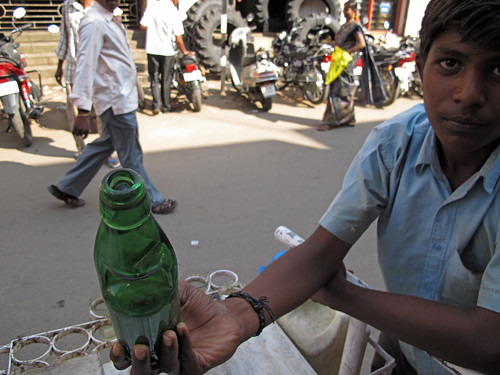
This is a poor photo of a very interesting bottle, despite the fact that the boy running this soda cart in Mysore was being super helpful. (Below, some clearer photos of this type of bottle, courtesy of Wikipedia.) This is known as the Codd-neck bottle and you can read a full history and explanation below, but in short, the bottle is sealed via the use of a glass marble held in place by the pressure of the aerated soda; pressing the marble down either with a thumb or wooden plunger releases the seal, dropping the marble into the curved cavity and allowing the soda to pour out.
This blog is, and always has been, ad-free. No sponsored/external content, and no, I don't want you to help me "monetize" it or improve my SEO. No solicitation emails please. Thanks for your attention to this matter.
This Blog
This blog is a long, somewhat messy photo essay on the history and politics of design. Design's socio-historical context—that is, the constraints and influences on the way we make objects, dwellings and cities—seems too often ignored. We no longer know where our styles, tastes or objects really come from, and this damages our creativity and sense of meaning. Historical knowledge is so fugitive in the New World, with everything so decontextualized in the rapid flow of commodities and images. Don't even get me started on tumblr and pinterest.
As Fran Lebowitz said, "Designers now, they all have these things called mood boards. I suppose they think a sense of discovery equals invention. It would be as if every writer had a board with paragraphs of other writers—'Oh, I'll take a little bit of this, and that, he was really good.' Yes, he was really good! And that is not a mood board, it is a stealing board."
As for the sort of design I'm personally interested in, full disclaimer.....read more
____________________________________
Book in Progress: Habitat
To read about my book project on Vancouver's UN-Habitat Forum event of 1976 concerning just and sustainable urban settlements, click here. Few know that Buckminster Fuller, Margaret Mead, Mother Teresa, Paolo Soleri and Maggie & Pierre Trudeau, along with many thousands of others, came to Vancouver in 1976 to talk about better, safer, fairer and greener cities worldwide. In fact it was the founding conference of UN Habitat, an agency built around a foundational document called The Vancouver Declaration. My book is about what happened that year and is a snapshot not just of Vancouver but of how people around the world began to view cities and themselves differently in the wake of, among other things, the first oil crisis.
____________________________________