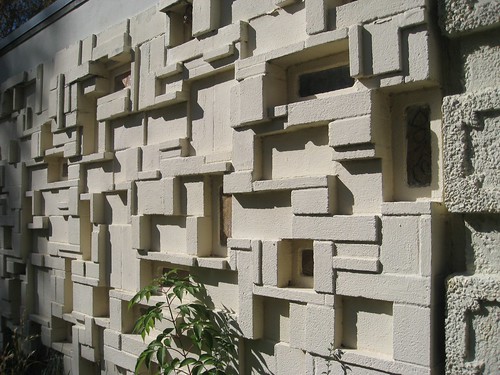
I’m developing a taste for these. There are lots of dinky suburban tract versions of these perforated walls, but when the scale and placement are well thought out, they can be the building’s most arresting feature.
December 10, 2009
I’m developing a taste for these. There are lots of dinky suburban tract versions of these perforated walls, but when the scale and placement are well thought out, they can be the building’s most arresting feature.
December 9, 2009
Concrete block and perforated screen fetishists should visit this Flickr pool. The wall above and below is at the abandoned Besser Vibrapac office, a building that served as a display of the company’s own concrete blocks.
December 8, 2009
William Cody, Architect, 1952. From the standpoint of the rainy temperate rainforest, desert landscaping is so seductive, so distant, so taunting. Red cactus soil, and an agave growing through the roof, and a boulder.
The Parker Hotel as photographed by Chimay Bleue, who has produced one of my favourite collections of photos of modernist architecture on Flickr. I’ll do a series of posts using his photos if he will let me.
December 5, 2009

Aqualta – New York and Tokyo by Studio Linfors.
“Aqualta – a play on Acqua Alta, the increasing high tides flooding Venice – visually explores what a coastal metropolis might feel like a hundred years from now due to rising sea levels.
November 27, 2009
City of Vancouver, why not just demolish the Planetarium, too, and all our other iconic, distinctive buildings while you’re at it? Do we even deserve architecture in this town?
November 17, 2009

Utopian soviet architecture, futuristic and sci-fi, photographed by Frederic Chaubin, editor of French magazine Citizen K. Interview and photos from Ping Mag. The architect who designed the building below was influenced by a sketch of an imaginary city drawn by a Russian artist.
November 14, 2009

Photo essay of post-war Yugoslavian monuments and architecture by Belgian artist Jan Kempenaers, from the Crown Gallery site. “Spomenik” means monument, and all of these structures were meant to commemorate WWII losses and point to progress and a generally utopian future.
November 11, 2009

New house in an old neighbourhood of Wroclaw, Poland, in the NYT today. Spruce on the outside, particle board on the inside, and the whole thing cost US$80,000 to build.
November 8, 2009

This chapel in Tarnów, Poland, is by Marta Rowińska & Lech Rowiński of the firm Beton (photos by Beton) and was completed in 2009. Being a completely non-religious non-churchgoer who really dislikes all the tortured religious iconography and narrative (and could do without the cross), I don’t know why I’m so attracted to all these humble churches (see also here and here) but I think it’s a relief to see a building whose utility is somewhat non-utilitarian and undefinable.