

This writing studio somehow comes as no suprise. James and the Giant Peach, Charlie and the Chocolate Factory, and Dahl’s disturbing adult stories were written in this cramped, somewhat decrepit room.
Categories:
design,
Uncategorised
April 12, 2009
This writing studio somehow comes as no suprise. James and the Giant Peach, Charlie and the Chocolate Factory, and Dahl’s disturbing adult stories were written in this cramped, somewhat decrepit room.
April 4, 2009

I love this art object/piece of furniture by artist Fia Backstrom, who has had a number of exhibitions in Vancouver. From the NYT article “Artful Lodgers“:
Fia Backstrom describes her apartment near the Gowanus Canal as a perpetual battle between organization and chaos.
April 3, 2009

From Portland Monthly Magazine. A monochromatic painting resting on a teak credenza becomes a sort of contemplative feature wall. Why is this picture so compelling to me? It’s not as if it’s that different from the thousand other midcentury modern still lifes I’ve seen in the past few years, but sometimes one variation on a theme stands out from the others.
March 15, 2009
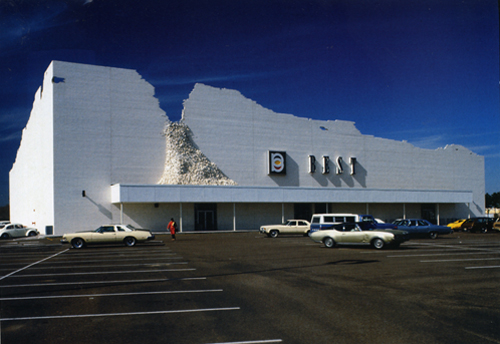
I first saw these amazing buildings, almost all of which have now either had their facades removed or have actually been demolished, in the November 2007 issue of Wallpaper. The BEST Products Company of Richmond, Virginia commissioned architect James Wines’ SITE (Sculpture In The Environment) to build nine commercial buildings for them in the 1970s and early 80s.
March 8, 2009

Young Meagher’s “Militant Guild of Rural Tailors” is apparently a fashion line that doubles as a faux-museological collection of objects and textiles purportedly belonging to a revolutionary worldwide underground cult of rural tailors reaching back into early 19th C history.
February 4, 2009

Textile looms and computers share a common history; Babbage used punch cards in his Difference Engine after seeing a Jacquard loom at work. This carpet by Richard Hutten is called “Playing With Tradition” and it plays on the historical relationship of looms and computers by looking exactly like a digital image that has been pixel-stretched.
January 28, 2009

“Dazzle painting,” devised in Britain during WWI, was based on the theory that complex optical patterns would confuse enemy naval rangefinders by disguising a ship’s speed and direction. It employed a number of visual tricks including the painting of false bow waves on rear portions of the ship rather than the prow.
January 23, 2009

See all Joo Youn Paek’s inventions here. Yes, they’re functional: as art.
January 4, 2009

The “What’s In and What’s Out in 2009” lists are starting to appear. Not to be too protestant about it, since environmentalism in its more puritanical moment can make you want to stab yourself in the eye with a fork—a plastic fork—but these lists can get anxiety-provoking.
December 14, 2008

Furoshiki is a traditional Japanese means of wrapping presents or carrying objects in a square of cloth. It’s waste-free, it’s practical, and it’s beautiful. As an art form, furoshiki is less known outside Japan than origami, but it is just as venerable – it simply uses fabric instead of paper.


