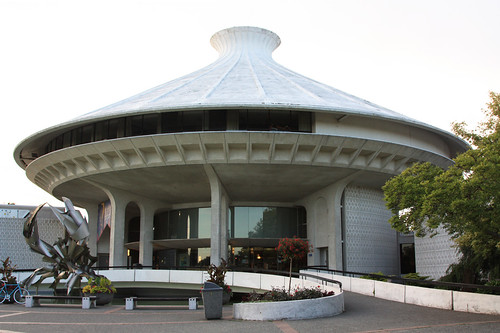
This is the paper-based pavilion designed by Arthur Erickson for the UN Habitat Conference on Human Settlements that took place in Vancouver in June of 1976. The pavilion, part of Habitat’s exhibit, was erected in front of the old courthouse (now the Vancouver Art Gallery).
I’ve liked this building from childhood, but somehow I managed to see it with fresh eyes recently – I was late for an art event there, it was dusk, I was tired, the entry was deserted and somehow I suddenly noticed how ridiculously beautiful it is.
It shouldn’t be that difficult; it comes apart. The owner residents of Tokyo’s famous Nakagin Capsule Tower have voted to demolish it and rebuild a “modern” tower on the same location, which is now a valuable property adjacent to the Ginza district.
This thing, known as McBarge by Vancouverites, is the hulking remains of a floating McDonalds. It was custom-built for our Expo ’86 World’s Fair and then carelessly left rusting in the harbour for 23 years as some sort of ghost ship.
The new convention centre, an entirely self-sustaining carbon neutral building, is more impressive than I predicted and is proof that environmental sustainability can actually coincide with beauty.
These stills were shot during the filming of Coast Modern, a documentary film about West Coast modern house architecture, spanning from LA to Vancouver, by Vancouver filmmakers Gavin Froome and Mike Bernard.
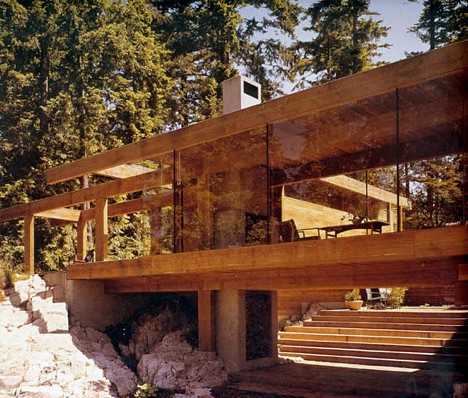
One last Vancouver house by Arthur Erickson. The house was built for and is still owned by the painterGordon Smith and his partner Marion. They have carefully maintained it over the years, in keeping with Erickson’s original design and intention.
Takashi Iwasaki‘s March show in Vancouver was postponed, so we’re doing our own little show here. Iwasaki, who was born in Japan and studied in both Japan and Canada, also produces paintings and drawings but it’s his embroideries that are particularly interesting, not just because it’s nice to see embroidery being done by a male artist, but also because of their unconventional, non-fussy style – he somehow bends the medium to make embroidery lines appear loosely hand-painted or drawn, so that there’s an interesting disjunction between method and effect.
The Russian Hall, formerly the Russian People’s Home, consistently produces typography so clear, so straightforward, so capitalized it is a manifesto in itself, design or political. This what happens when you try to produce design degree zero: the more you eschew style, the more you achieve it.
This blog is, and always has been, ad-free. No sponsored/external content, and no, I don't want you to help me "monetize" it or improve my SEO. No solicitation emails please. Thanks for your attention to this matter.
This Blog
This blog is a long, somewhat messy photo essay on the history and politics of design. Design's socio-historical context—that is, the constraints and influences on the way we make objects, dwellings and cities—seems too often ignored. We no longer know where our styles, tastes or objects really come from, and this damages our creativity and sense of meaning. Historical knowledge is so fugitive in the New World, with everything so decontextualized in the rapid flow of commodities and images. Don't even get me started on tumblr and pinterest.
As Fran Lebowitz said, "Designers now, they all have these things called mood boards. I suppose they think a sense of discovery equals invention. It would be as if every writer had a board with paragraphs of other writers—'Oh, I'll take a little bit of this, and that, he was really good.' Yes, he was really good! And that is not a mood board, it is a stealing board."
As for the sort of design I'm personally interested in, full disclaimer.....read more
____________________________________
Book in Progress: Habitat
To read about my book project on Vancouver's UN-Habitat Forum event of 1976 concerning just and sustainable urban settlements, click here. Few know that Buckminster Fuller, Margaret Mead, Mother Teresa, Paolo Soleri and Maggie & Pierre Trudeau, along with many thousands of others, came to Vancouver in 1976 to talk about better, safer, fairer and greener cities worldwide. In fact it was the founding conference of UN Habitat, an agency built around a foundational document called The Vancouver Declaration. My book is about what happened that year and is a snapshot not just of Vancouver but of how people around the world began to view cities and themselves differently in the wake of, among other things, the first oil crisis.
____________________________________